Category Archives: Uncategorized

Why will my dog not come when called! How can I make them want to come?

Do you have a dog that comes when called? Eagerly? Happily? No matter what else is going on in their world of scents, other dogs, and squirrals? Or, is this a more familiar scenario?

The other day  I heard the familiar sound of my friend calling for her dog. Suzy! come! Come Suzy! COME! COME RIGHT NOW! Suzy! I go out on the porch to see a very frustrated friend running after her dog; wondering why she was living with this runaway roommate.
Turns out they had been visiting a friend.  Instead of getting into the car when it was time to go; Suzy went for a joyful run around the block with my friend chasing behind her yelling COME!

Coming when called is one of the most important lessons you can teach your dog.

Your dogs safety depends on learning to come when called. No one wants to see their dog hit by a car, or lost while hiking.  If you have a dog that won’t come when called, never let them off of a leash in an area that they can escape and potentially get lost or hurt themselves.Important to be on a leash
What can you do if they have escaped?

Try running away from them, while calling their name or making silly noises.  This instigates the game of chase. Once they catch you act very happy and do not reprimend them. The act of coming to you needs to be a positive act.

What if running away from them doesn’t work?

If they are close enough to see you, drop down and start acting like something is wrong. Start crying. Sobbing! Silly noises. They will have to come to investigate. Once they are close clip the leash on their collar. Again, Do not punish them. If punished when they come, they will associating coming with a negative experience.

How can you train your dog to not only come, but do so happily?

A dog wants to come because it is in his best interest. The reward of  coming  to you has to have a bigger payout and override all the other scents and exciting things to see while they are on the run. If every time they come to you they are leashed and the fun is over, or they get yelled at, your dog will never want to come to you. They will associate coming as a negative experience. Instead, turn this into a positive experience. On your walks, or throughout the day, just call them to you and reward them with praise or treats. Throw a ball for them. Then let them go back to sniffing or chewing on that bone. Make it a positive experience.
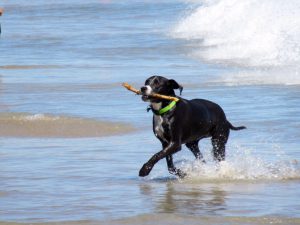
Learning to come while playing

Learning to come while playing

Make it a pay day everytime they come!

An easy way to make it a pay day is to always carry treats with you. High paying treats! A dog trainer friend said she carried steak as a treat for her run away pup for almost two years! Not saying it has to be steak, but make it worth coming. Be sure to also give lots of praise and use a happy voice. Mix it up by throwing praise and no treats. Keep your dog guessing and interested. Be careful not to quit giving treats all together. As my trainer friend said, “Would you go to work if you didn’t get paid?”

What steps can you use to teach your dog to come? Here are a few many trainers use. 

Start with small steps. Your dog is on a leash. Ask them to come, then start moving backwards, away from them. When they follow you say, ” yes!” Use an excited voice.  Let them catch you. Then give them a treat and praise. Lots of Praise! Like people dogs will get burned out and quit learning if you do it too often. I have found a few times a day seems to work the best.  You can also incorporate it into your walks. Just a few times a day should teach your dog the command come.  As your dog gets better at the recall use a longer leash.  This may take awhile, but as they learn that coming is a positive experience, they will get better and better.

When you feel your dog has learned to come when called it is time to do it off leash. Make sure you are in an enclosed area. Call your dog to you. Once. If they do not come do not be angry, or continue to call. Go to them and put them on the leash, no praise, no treats. Go back to on leash training. Your dog will soon learn they only get the treats when they come.

Another fun game is to call them and run away so that they will chase you. If you have partner to help, they can hold your dog while you go to another room. Then you call your dog, the partner lets your dog go, and they come find you. Once they are with you praise them, treat them, and be very excited. Can you think of any more fun games? I would love to hear them.

What NOT to do if you want your dog to come when called.

  • Do not give your dog the opportunity to run away. Always have your dog on a leash when circumstances are that they could get lost or potentially hurt.
  • Do not run after your dog when they don’t come. This creates the game of Chase!
  • Do not reprimand your dog when they do come to you. This creates a sense of fear and associates coming with negative reactions.
  • Always reward your dog when they come to you. Whether it be praise, treats, toys, make it a big pay day. Make your dog associating coming to you with the best outcome ever!

Do you have any tips that have been successful in teaching your dog to come? I would love for you to share them!

Thank you for visiting! Molly and I are off to practice a few recalls.

Linda
 

My dog was stung by a bee!

Sunshine, barbecue, friends, a perfect summer afternoon interrupted by a yelp! My friend’s Puggle, Tucker, had been stung by a bee!

What to do?

Luckily, I had experienced a similar situation while traveling with a friend from Mexico to Washington. We were about two hours out of Matzatlan, when another friend’s dog, Emma, was stung and her face started swelling. Due to my own allergies I always have Benadryl, (diphenhydramine which is the generic name) on hand, which we immediately gave her and headed to the nearest vet, two hours away.

The normal Benadryl dosage for a dog is 1mg per pound of body weight, no more than two or three times a day.

Emma, a golden retriever,  weighed close to 70 pounds so we knew two Benadryl wouldn’t hurt her.  In Emma’s case we had to administer two more before the swelling stopped getting worse. In Mazatlán we found a veterinarian to further her treatment.

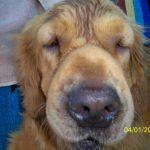
Emma swollen from a bee sting

Because of this previous experience I was able to administer the proper Benadryl dosage for Tucker, who then got relief from his sting. Tucker,  a 25 pound Puggle, one pill was a big enough dosage. His reaction was not as bad as Emma’s so a veterinarian visit wasn’t needed. Remember though you should always contact your veterinarian if you are not sure. We would have called or visited a veterinarian immediately with Emma had one been closer.
Dogs like people have allergic reactions, some worse than others. In Emma and Tuckers cases their face swelled very quickly. Another dog’s reaction might have been more subtle, such as scratching and you might not even notice.

More uses for Benadryl.

Benadryl can also be used to calm a stressed dog. I have given it to Molly to help calm and relieve her stress during thunder storms, fireworks,  and hunting season. It can also be given to help a dog who gets carsick. I pack Benadryl with me as part of an emergency kit.
Always check with your veterinarian in case there is a reason your dog shouldn’t take Benadryl.

Until next time.

Linda and Molly

The Three Most Important Commands to Teach your dog.

Sharing your space with a four legged friend is a lot like having a two or three year old living with you. Sometimes they will refuse to do what you ask, throw temper tantrums, and then in the next minute give you those I love you looks. It has been my experience, no matter how much you love them, both children and four legged family members, commands need to be learned for their own good and the peace of the household.
The normal commands like sit, stay, down, and come are taught in most obedience classes which are very important, but I have three more that I think are priceless. Leave it. Wait. OK.

The number one command that I taught Molly was “leave it“. This command can be used in many situations. The original reason for having her learn it was to keep her from eating strange stuff found on the ground. Leave it has turned into so much more and can be used in numerous situations. For example:

Molly and I were walking along our rural road admiring the scenery when I noticed a mama Ptarmigan and her brood of five babies sitting beside the trail. Molly noticed them as well and started to show interest. I immediately told her to leave it. Molly never quit showing interest but did not rush them. Instead they flew off as we got closer while she quietly watched them. Did I mention Molly was off leash? I have used this command over and over again in regards encountering wild animals, but it also helps when encountering other dogs. As you can see in the next example:

We are walking along a city block and Molly is on leash. A loose dog rushes to the edge of his yard to bark and greet her. I tell Molly to leave it and we walk by without issue. Molly is completely aware of this barking dog, but ignores him.  Leave it can also be used when it comes to toys, sticks, dead things, whenever it is appropriate. Remember, “Leave it“.

Another handy command is wait. Unlike the command stay, which means don’t move from that space, wait is more of a temporary command.  Wait to get out of the car. Wait to pass through the door. My favorite time to use this one is; wait to go down the stairs. This became very important when my elderly mom was living with us. Molly would want to rush down the stairs, which would potentially cause my mom to fall or in the very least cause mom fear of falling. Instead, mom would start down the stairs and I would tell Molly, wait.  Molly would stand on the stair and wait until I told her OK, then she would go a few steps behind us and I would tell her wait again. This would continue until we were all safely down the stairs. Wait and then the release word OK. Which brings me to another important peace of the puzzle. The release word. Very, very, important.

The Release Word.

Have you ever had a dog that on command sits, gets their treat or pet, then jumps up and  runs off? Turns out this is because they haven’t learned the release word. You can use whatever word you want, but you need to teach a release word. I use OK. Molly sits. We practice sitting for different lengths of time and she gets treats for sitting. When it is time to release her, I say OK. In the beginning to teach them the release word just say the word and act excited, clapping, good boy, whatever to make them move. They will catch on pretty fast.

How do you teach them leave it?

As I said earlier the original reason to teach ‘leave it” was to keep them from eating food and dead stuff. So to introduce this lesson use food. In the beginning have a treat in both hands. Show them one enclosed fist and say leave it. Your dog will try to lick, mouth, bark, and try to get to the food. Just ignore his behaviors. Once he quits, immediately give him the treat from the other hand. Work with this until he looks at you instead of asking for the treat. Always give him the treat in the other hand. When you have good success with this stage of the game move on to the next step.

At this stage you need to have control over your dog. I usually put them in a down as it is harder for them to lunge at the treat.  Then while holding onto their collar I put a piece of wonderful yummy just out of their reach and tell them leave it. Now while they are drooling over wanting that piece of yummy I give them another yummy that is even better than the one out of reach.  DO NOT give them the one you told them to leave! Just pick it back up and give them another treat. They will catch on pretty quick but don’t move forward too fast. Baby steps.

How to teach Wait.

To teach wait you use the same principle as stay. On leash have them sit and tell them to wait. Give them a treat or series of treats then give your release word. I do not think I ever truly taught Molly wait through on purpose training. It evolved in our everyday life, but I will continue to use this command as it is has been so useful. Training happens in everyday life. I highly recommend you find a local dog group with a reputable trainer to help you get started. I always start there. Our community has many groups, from private trainers to kennel clubs. Check your area. You might make some great friends and both you and your four legged room mate will not regret it.

Have fun, Till next time.

Linda and Molly